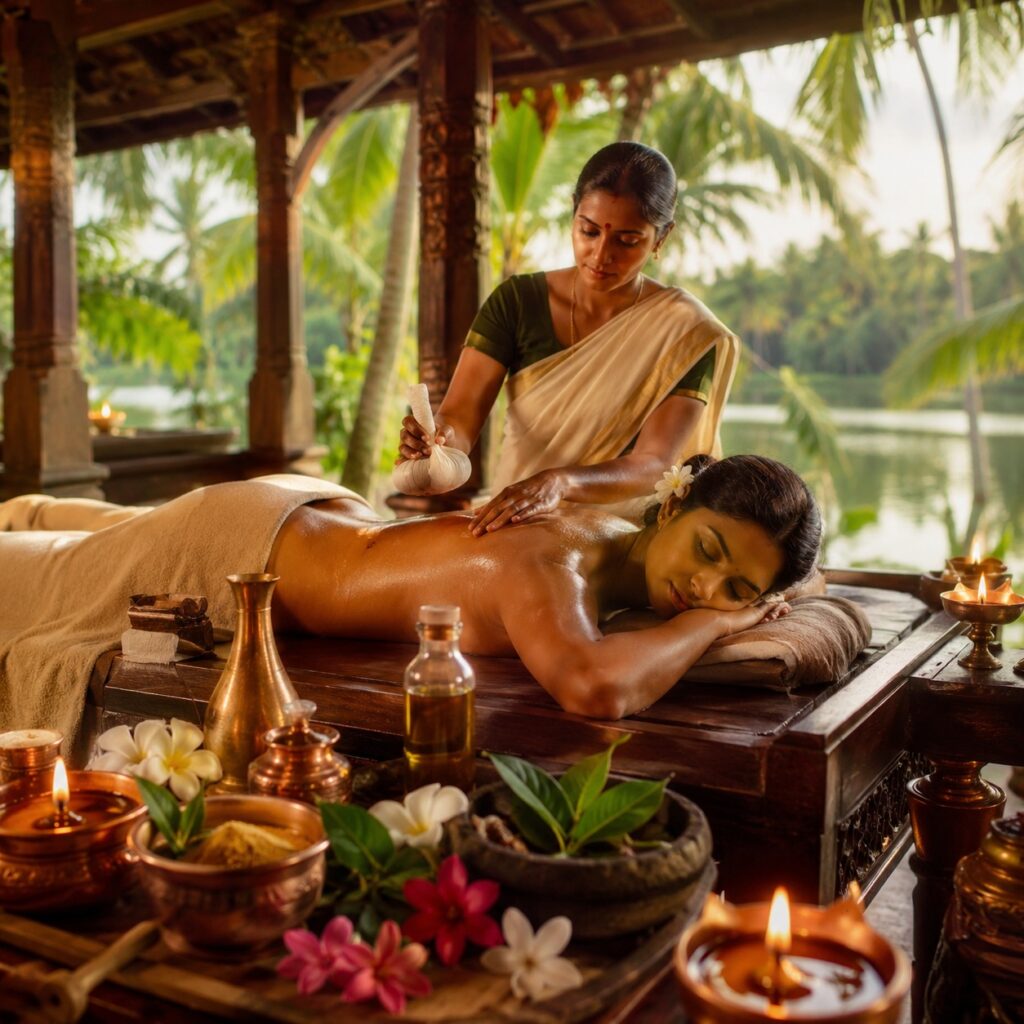
You can travel across India and find a hundred reasons to pause, but Ayurveda grabs you differently. It doesn’t shout. It doesn’t perform. It just sits there quietly until your body admits it needs help.
Kerala is where this whole system breathes the easiest. The forests, the coast, the weirdly calm rhythm of daily life, everything forms a kind of backdrop that makes the old recipes feel alive.
Ayurveda didn’t move here.
It grew here.
And that difference shows.
Walk into the Best Ayurvedic Center in Kerala on any morning. You’ll hear chants somewhere far off, soft enough you can’t trace the direction. You’ll smell oils warming on stoves. You’ll see old wooden treatment tables polished by decades of hands, linens stacked with the neatness only grandmothers usually achieve, and therapists who watch your posture the way a tailor studies a suit.
This isn’t a spa pretending to be traditional.
It’s the place where the tradition was born.
When you arrive
Most people arrive carrying more weight than their suitcase.
Stress sits in their shoulders.
Sleep hangs in half-broken pieces.
Their breathing never drops below fourth gear.
You don’t even have to explain this.
Your therapist sees it.
Ayurvedic practitioners have a knack for reading the subtle stuff. The way you sit. The way you answer simple questions. The way you hold your jaw without noticing.
They scan your face, pulse, appetite, digestion, mood, the kind of tea you prefer, everything.
It feels strangely intimate, but not invasive. More like someone dusting a shelf that’s been ignored for years.
Then there’s the pulse reading.
Three fingers lightly pressed.
Eyes closed.
A silence that stretches.
If you’re new to Ayurveda, this part feels mystical.
If you’re not, it feels precise.
They decide your dosha mix.
Vata. Pitta. Kapha.
Everyone has their own blend. No two bodies need the same medicine. No two people receive the exact same plan.
This is why Ayurvedic treatments in India hit differently.
It’s not what you’re given.
It’s the intention behind it.
Your daily rhythm shifts
Mornings arrive quietly. No alarms. No rush.
You hear birds before you hear anything human. Kerala’s wildlife doesn’t understand personal space. Crows negotiate aggressively. Koels whistle like they’re auditioning. Even the wind participates.
Breakfast shows up early. Always warm. Usually simple. Porridge, or dosa, or steamed rice cakes with coconut chutney that tastes like someone made it by hand rather than a blender. Ayurvedic kitchens are the opposite of buffet culture. No piles of food. No sugary traps. Just meals designed to calm your gut rather than confuse it.
You feel full without feeling heavy, which is something modern food rarely manages anymore.
Your first treatment starts almost immediately after.
Warm oil on your forehead. The slow drip lines your eyebrows and slides into your hair.
Your mind shuts up faster than you ever expected.
Thoughts don’t stop, but they lose their sharpness.
It’s like they lose their edges.
This is Shirodhara, the treatment everyone talks about. And for good reason. It’s the closest thing to liquid meditation.
Then come the massages.
Two therapists. Perfectly synced movements.
Long strokes that feel like someone ironing tension out of your spine.
The table is wood, heavy and carved, not cushioned. That alone tells you how old this system is. Ayurveda doesn’t adapt to modern furniture. It makes you adapt to it.
By the end, your skin shines like someone dipped you in a pot of sesame oil.
You smell slightly herbal, slightly smoky, slightly like someone’s kitchen at 6 am.
You don’t mind.
Your body feels lighter.
Different treatments, different reactions
No two treatments hit the same way.
Abhyanga
The full-body oil massage.
You walk in with tight shoulders.
You walk out wobbling like you forgot your bones at the door.
Kizhi
Hot compresses filled with herbs or rice.
They tap against your skin, soft but firm.
It feels like the warmth drills into the muscle and asks, “You want me to loosen this knot or leave it for later?”
Njavarakizhi
Rice cooked in milk and herbs.
Applied in rhythmic strokes.
Your skin drinks half of it. The rest slides away like glue that never learned to stick.
Pizhichil
Warm oil poured continuously.
People call it “the royal treatment,” though no one here romanticizes it that way.
It’s simply effective for pain, fatigue, and joints that have been complaining since your twenties.
Steam baths
Small wooden chambers.
You sit inside like a piece of marinated chicken.
Your head stays outside.
The rest of you melts.
Ayurveda doesn’t try to impress you.
It tries to fix you.
There’s a difference.
Some guests stay 7 days.
Some stay 21.
The long programs hit deeper, the way a deep clean hits more thoroughly than a surface wipe.
You eat food planned for your dosha.
You drink herbal teas that taste strange on day one and comforting by day five.
You learn when your energy dips and when your mind becomes sharp.
Ayurveda doesn’t just treat the body.
It teaches you how your body operates.
The learning curve
You start noticing patterns.
Your cravings shift.
Your sleep sharpens.
Your hunger arrives on time instead of barging in like an unruly guest.
You learn that certain foods dry you out.
Others heat you.
Some calm your stomach like a lullaby.
This knowledge doesn’t come from lectures.
It comes from living inside your body more attentively.
The treatments create that space.
People assume Ayurveda is soft.
It isn’t.
It’s rigorous.
Your body works hard to rebuild itself.
The oils, herbs, steam, and meals reset the internal wiring.
You can feel it every day.
Sometimes subtly.
Sometimes like someone flipped a switch.
Afternoon routines
Afternoons are slow.
You sit on verandas with a book you barely read because your mind refuses to multitask.
You watch leaves fall.
You watch boats pass.
You watch your thoughts assemble themselves without your interference.
The retreat encourages silence.
Not forced silence.
Just the absence of pointless noise.
Some days you do yoga.
Not the Instagram version.
The slow version.
The version where breathing takes priority over bending.
You sweat.
You stretch.
You feel foolish.
Then you feel good.
By evening, the lamps light up around the pathways.
Dinner tastes different every day, even when the dishes look similar.
Ayurvedic food never leans into extremes.
No heavy spices.
No chilly bombs.
No sugars disguised as health.
You notice how calm your stomach feels.
People underestimate this shift.
Digestion influences everything.
When the changes settle in
Around day 5 or 6, something shifts quietly.
Your sleep gets deeper.
Your thoughts stop sprinting.
Your face looks less pulled.
Your shoulders drop an inch lower.
You stop thinking about productivity.
You stop thinking in timestamps.
Your body decides the schedule for once.
This is the part that surprises guests the most.
Ayurveda doesn’t hammer you into stillness.
It walks you there gently.
Your body takes the lead.
The rest follows.
Kerala carries the experience
Even if you removed the treatments, Kerala still feels like medicine.
The air tastes slightly salty near the coast.
It smells like cardamom in the hills.
It sounds like monsoon on tin roofs and distant temple songs drifting over coconut trees.
Travelers who come for Ayurveda end up staying for the environment.
The slowness.
The warmth.
The simplicity that modern life sheds too quickly.
You start noticing small things:
How the sky shifts color three times before sunset.
How the local fruit tastes like it grew a few hours ago.
How people walk with a pace that doesn’t seem fueled by stress.
Everything around you slows the mind before the treatments even begin.
The science and the feel of it
Ayurveda uses herbs you’ve never heard of.
Ashwagandha.
Brahmi.
Punarnava.
Shatavari.
Some taste like they could wake the dead.
Some taste like childhood cough syrups you secretly liked.
But the body responds.
You feel it in your muscles, your skin, your digestion, your mood.
It’s not magic.
It’s accumulated wisdom, shaped by trial, error, and observation over centuries.
When you quiet the system, the body repairs itself faster.
Ayurveda gives it the right environment.
This is why clinics in big cities can’t recreate the same effect.
The environment matters.
Kerala’s climate, soil, herbs, food habits, and rhythm create a natural container for healing.
What long programs feel like
People who stay 14 or 21 days see deeper changes.
Old pains soften.
Sleep becomes predictable.
Breathing steadies.
Energy returns without caffeine.
You feel less reactive.
Less jumpy.
More centered.
Some call it clarity.
Some call it alignment.
Some call it peace.
Call it whatever you want.
Your body knows the difference.
Leaving Kerala
Leaving the Best Ayurvedic Center in Kerala feels like leaving a place that understood you better than most people do.
You walk out with bags that smell faintly of oils.
You carry herbal powders wrapped in brown paper.
You promise yourself you’ll maintain the routine.
Maybe you will.
Maybe you won’t.
But your body remembers what balance felt like.
You return home slower.
Your face softens.
Your breath deepens.
Your patience regrows.
The real effect of Ayurveda isn’t what happens on the treatment table.
It’s the part that stays after the trip ends.
Why Ayurveda in Kerala works
Ayurveda elsewhere feels educational.
Ayurveda in Kerala feels lived.
There’s a difference you can’t explain with data or pamphlets.
It’s in the hands of the therapists.
It’s in the herbs grown a few miles away.
It’s in the kitchens where meals taste like medicine without feeling medicinal.
It’s in the quiet confidence of the doctors who’ve practiced this art for decades.
It’s in the rain, the heat, the rivers, the forests, the stillness.
Healing isn’t a product you buy here.
It’s an environment you enter.
And that stays with you.
Long after the oils wash off.
Long after the flight home.
Long after the routine resumes.
Kerala gives you a version of yourself you might’ve forgotten.
Ayurveda brings it back.
You Might Also Like
- Best Ayurveda Retreats in Kerala — Where to Go → : best Ayurveda retreats in Kerala
Whatsapp/Call: +91 9319002744
Email: info@indiatourmantra.in
Website: www.theindiavoyages.com
Ayurveda is an ancient Indian healing system focused on balancing the body, mind, and lifestyle through natural therapies, herbal medicines, diet, yoga, and detox treatments.
Popular Ayurvedic therapies include:
Panchakarma Detox
Abhyanga (Herbal Oil Massage)
Shirodhara
Nasya Therapy
Basti Treatment
Stress & Anxiety Therapy
Arthritis & Pain Management
Weight Loss Programs
Skin & Hair Treatments
Kerala is considered the most famous destination for authentic Ayurvedic treatments due to its traditional wellness centers, experienced doctors, and natural healing environment.
Panchakarma is a detoxification and rejuvenation therapy in Ayurveda designed to remove toxins from the body and restore balance through cleansing procedures and herbal therapies.