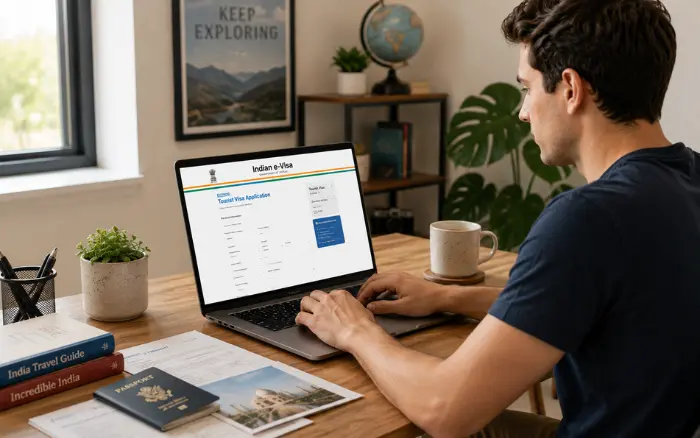
Most people planning an India trip for the first time spend more time worrying about the visa than they need to. The process is genuinely simple for most nationalities. Here’s what you actually need to know.
The e-Visa is almost always the right choice
Citizens of 166 nationalities are eligible to apply for an India e-Tourist Visa online, including travellers from the US, UK, Canada, Australia, most of Europe, and most of Southeast Asia. The entire process happens online. No embassy visit, no paper forms, no queuing.
The e-Tourist Visa comes in 3 durations: 30 days, 1 year, and 5 years. Pick based on how long you plan to stay and whether you’ll return.
The 3 e-Tourist Visa types explained
30-day e-Tourist Visa: Valid for 30 days from your first arrival in India, with double entry. Suits most first-time visitors on a 2-3 week trip. You can now apply up to 120 days in advance, so there’s no need to cut it close.
1-year e-Tourist Visa: Valid for 1 year from the date the visa is granted, with multiple entries. Maximum continuous stay per visit is 180 days. Good if you’re planning a longer trip or might return within the year.
5-year e-Tourist Visa: Same rules as the 1-year, but valid for 5 years. Makes sense if you travel to India regularly.
What it costs in 2026
Fees are set in US dollars and vary by nationality. For most nationalities including the UAE, Saudi Arabia, UK, EU countries, Canada, and Australia, the 30-day e-Tourist Visa costs $10 in the off-season (April to June) and $25 during peak months.
The 1-year visa costs $40 for most nationalities. The 5-year visa varies more significantly: UK passport holders pay $484, while US citizens pay $160.
A bank transaction charge of 3% applies on top of the base fee. The fee is non-refundable regardless of whether your application is approved or rejected.
How to apply: step by step
Go to the official Indian government portal: indianvisaonline.gov.in. Avoid third-party sites that charge service fees on top — the government portal is free to use beyond the visa fee itself.
You’ll need: a valid passport (minimum 6 months validity from your arrival date, with at least 2 blank pages for stamping), a recent passport-size photograph with white background, the first and last page of your passport scanned, and a return or onward flight booking.
Fill in the form, upload your documents, pay the fee, and wait. Processing takes 3-4 working days for most applications. Apply at least a week before your travel date to account for delays.
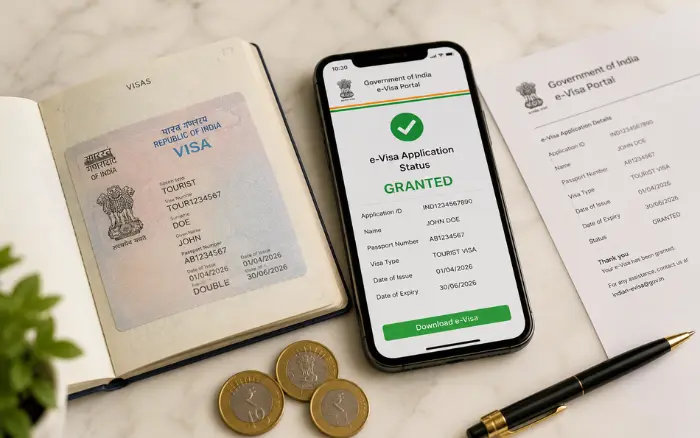
Once approved, you’ll receive an Electronic Travel Authorization (ETA) by email. Print it or save it on your phone. Carry a copy when you travel, and check that your ETA status shows “GRANTED” before you leave.
Where you can enter India on an e-Visa
The e-Tourist Visa is accepted at 33 airports, 19 seaports, and 4 land border crossings. All major international airports are covered: Delhi, Mumbai, Bengaluru, Chennai, Kolkata, Hyderabad, Jaipur, Cochin, Goa (both Dabolim and Mopa), Varanasi, and more.
You can exit through any authorised immigration checkpoint, not just the one you entered through.
One new requirement: the e-Arrival Card
All foreign travellers must now submit an e-Arrival Card online within 72 hours before arriving in India. This is a separate step from the visa. It’s quick (takes about 5 minutes), but easy to forget. Add it to your pre-departure checklist alongside online check-in.
When the e-Visa doesn’t apply
Pakistani nationals cannot apply for an e-Visa and must apply through the regular visa process at an Indian mission. The same applies to holders of diplomatic or official passports, and travellers who share a passport with a family member (each person must hold their own separate passport).
If you’re travelling to restricted or protected areas (certain parts of the Northeast, Andaman Islands, or border regions), the standard e-Tourist Visa may not be sufficient. Check in advance with the Indian mission in your country.
You Might Also Like
Start Planning Your India Journey Today! Click here:
Please feel free to contact us at any time for any other travel information, tour bookings, tickets, transportation, or hotel bookings in India. Just call or WhatsApp us at : +91 93190 02744
For more tour packages, visit our website: The India Voyages
FAQ
Q1. What is the easiest way to get an India tourist visa in 2026?
The e-Tourist Visa is the simplest option for eligible nationalities. Apply online at indianvisaonline.gov.in, pay the fee, and receive your Electronic Travel Authorization by email within 3-4 working days.
Q2. How much does an India tourist visa cost in 2026?
Fees vary by nationality. For most travellers, the 30-day e-Tourist Visa costs $10 (April-June) or $25 (July-March). The 1-year e-Tourist Visa costs $40 for most nationalities. A 3% bank transaction charge applies on top.
Q3. How far in advance should I apply for an India tourist visa?
Apply at least a week before your travel date. You can apply up to 120 days in advance, and processing takes 3-4 working days for most applications.
Q4. Can I extend my India tourist visa once I’m in the country?
The e-Tourist Visa is non-extendable and non-convertible. If you need more time, you’d need to leave and reapply. Long-stay plans are better served by the 1-year or 5-year e-Tourist Visa from the start.
Q5. What is the e-Arrival Card and is it mandatory?
Yes, it’s mandatory for all foreign visitors. The e-Arrival Card is a separate online form you must submit within 72 hours before arriving in India. It takes about 5 minutes to complete and is different from your visa.